• Pay My Bill
  • Careers
  • Donate
  • My Chart
  • +1 (844) 401-0111
Brain Research and Interventional Neurotherapeutics <br> (BRaIN) Program

Brain Research and Interventional Neurotherapeutics
(BRaIN) Program

BRaIN Programs

The Brain Research and Interventional Neurotherapeutics (BRaIN) Program at Butler Hospital involves a combination of research and clinical treatments within interventional psychiatry that focuses on advanced treatments for mental health disorders for individuals who do not respond to traditional therapies like medication and psychotherapy.

This subspeciality within psychiatry includes treatments such as Electroconvulsive Therapy (ECT), Transcranial Magnetic Stimulation (TMS), Esketamine (Spravato), PRISM neurofeedback, self-neuromodulation, and new cutting-edge modalities for major depressive disorder, obsessive compulsive disorder, post traumatic stress disorder, addiction, bipolar disorder, and other Neuropsychiatric disorders.

This unique program is integrated with scientific research to help develop personalized treatment approaches, target patient-specific symptoms, and identify potential biomarkers to predict clinical response and optimize outcomes.  

We are here to help

Butler Hospital
345 Blackstone Boulevard
Providence, RI 02906

You may click on the individual programs below to learn more information about those treatments and what steps to take to begin the screening process with our team.

For general questions, please call (401) 455-6632 to speak to a member of our BRaIN program. 

Our Treatment Programs

TMS Clinic-4

According to the American Psychiatric Association, ECT is considered the most effective treatment for major depression for people who have not found relief of their symptoms from medications or other forms of therapy. 

esketamine

Esketamine, marketed as Spravato, is the first FDA- approved treatment version of a drug commonly known as “ketamine” for adults struggling with major depressive disorder. It is used as a self-administered nasal spray and delivered under the supervision of trained professionals. 

TMS Clinic-3

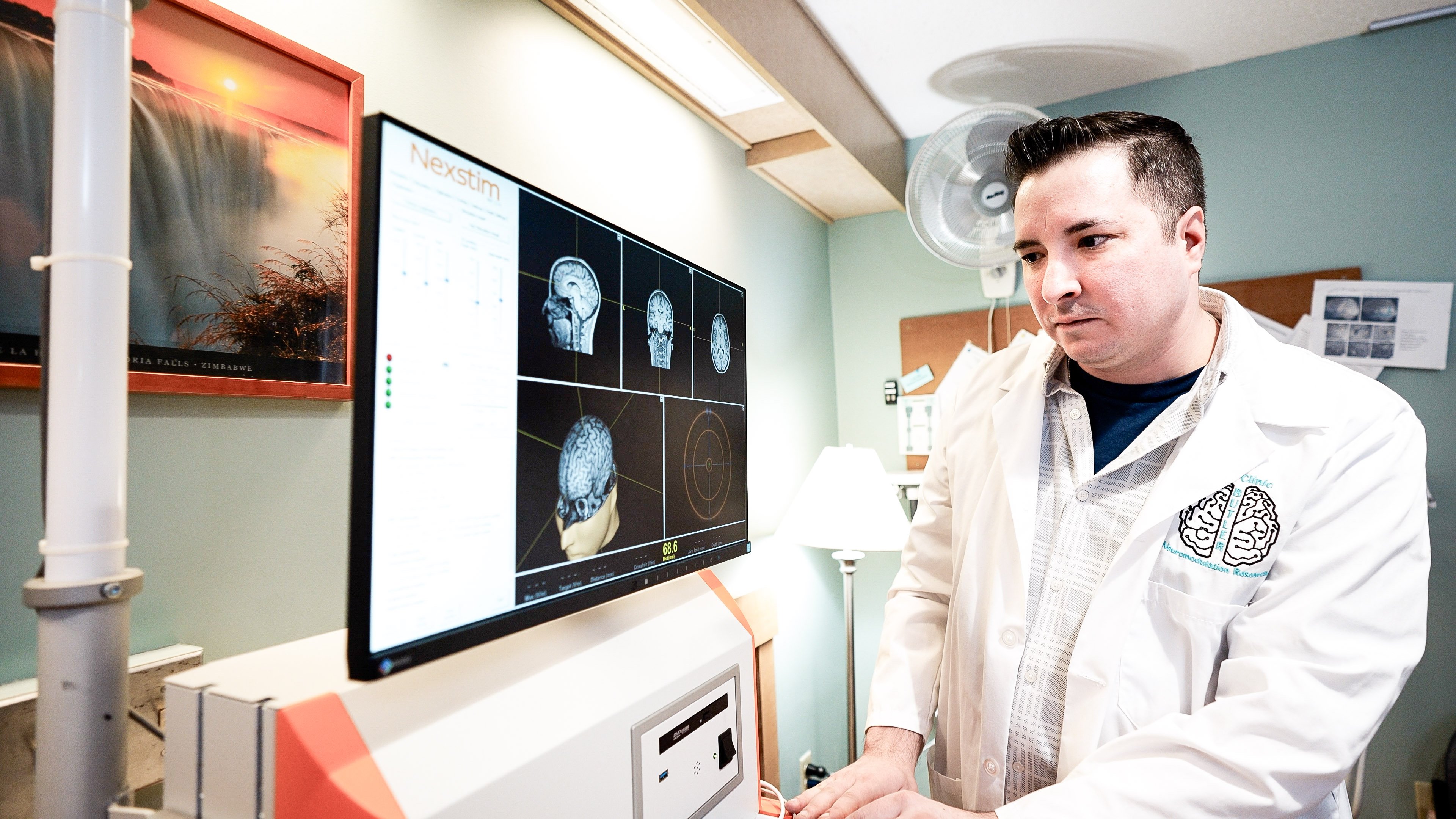
Transcranial Magnetic Stimulation (TMS) is a revolutionary treatment, approved by the FDA, for patients suffering from depression and obsessive-compulsive disorder (OCD) who have not responded to standard medications and therapy.

PRISM Self-Neuromodulation 4

PRISM is an FDA-approved, medication-free treatment that uses guided EEG to help individuals with PTSD regulate overactive areas of the brain and reduce symptoms. Now offered at Butler Hospital through the BRaIN Program, it provides a groundbreaking, outpatient option for those seeking lasting relief from PTSD.


Not sure which program is right for you?

Call Our Assessment Team

Why Choose Us?

  • Delivered through Butler’s BRaIN Program, a nationally respected center for advanced neurotherapeutics
  • Led by clinicians specializing in interventional psychiatry, including experts in TMS, Esketamine (Spravato®), and ECT
  • Informed by active neuroscience research, ensuring PRISM is guided by up-to-date clinical evidence
  • Supported by Butler’s role as the primary psychiatric teaching affiliate of The Warren Alpert Medical School of Brown University
  • Patients benefit from a team experienced in complex PTSD care and emerging brain-based treatments
  • Ongoing quality monitoring promotes consistent, safe, and continuously improving patient outcomes

Program Leadership

Linda Carpenter, MD

Chief, Clinical Provider

Linda L. Carpenter, MD is a Professor of Psychiatry in the Alpert Medical School of Brown University and Chief of the Mood Disorders Program at Butler Hospital. She completed her undergraduate degree at the University of Michigan and medical school at the University of Pennsylvania. She did an internship in internal medicine, psychiatry residency, and research fellowship at Yale, and then joined the faculty of the Department of Psychiatry and Human Behavior, Alpert Medical School of Brown University in 1997. 

Eric Tirrell

Director

Mr. Eric Tirrell completed his undergraduate degree in psychology at the University of Rhode Island.  He is the TMS and Esketamine clinical supervisor of Butler Hospital’s TMS Clinic and has been providing TMS treatment for neuropsychiatric disorders for over 8 years. He has extensive experience with all aspects of TMS clinical care and he is well versed in operating Neurostar, Magstim, Nexstim, MagnMore, Magventure and other investigational TMS device systems using a variety of TMS protocols and coils.

Clinical Providers

Alvaro Olivares, MD

Dr. Alvaro Olivares graduated from the Universidad del Norte Faculty of Medicine in Barranquilla, Colombia and completed his residency at Butler Hospital. He is a board-certified psychiatrist who serves as the unit chief in psychiatry at Butler Hospital and hosts a weekly Spanish radio program, “Mental Health with Dr. Olivares.” Dr. Olivares conducts assessments in Spanish for the program’s A4 study.  He currently serves as the chief of the Kent inpatient Unit at Butler and the Chief of the Outpatient ECT department.  

Meghan Kulak, MD, PhD

Dr. Kulak graduated summa cum laude with a B.A. from Cornell University in 2015 with a major in Biological Sciences and concentration in Neurobiology and Behavior. She worked as a research assistant in Immunology at the Jackson Laboratory for Genomic Sciences for two years prior to attending medical school. She received her M.D. and a certificate in public health in 2021 from the University of Connecticut. Dr. Kulak completed residency training in psychiatry at Brown in 2025. While at Brown, she was an active member of the R25-funded Research Training Program and the Resident as a Teacher Program, through which she was awarded the Positive Champions of the Learning Environment Dean’s Award in 2022. Dr. Kulak was awarded the Martin B. Keller Award for the Outstanding Resident in 2025 for her accomplishments. Dr. Kulak is currently a staff psychiatrist at Butler Hospital specializing in obsessive compulsive disorder and interventional psychiatry. Her research centers around developing and implementing brain-based interventions for obsessive compulsive disorder.

Martin Furman, MD

Dr. Furman has been at Butler Hospital for 40 years. At present, he is Chief of Intensive Treatment Programs as well as the Electroconvulsive Therapy Department. He has been active over the years in teaching Fellows, Residents, Nursing Students and Medical Students. He is a Clinical Associate Professor at Brown University in the Department of Psychiatry and Human Behavior. Administratively, Dr. Furman was President of the Butler Hospital Staff Association for a double term. He has been the recipient of a number of awards from Butler Hospital, Brown University, and the Community.

Brian Theyel, MD, PhD

Brian Theyel, M.D., Ph.D. is a Psychiatrist with a research interest in deploying basic neuroscience-based techniques to understand brain abnormalities underlying neuropsychiatric diseases, and to help develop treatments based on what he learns. His work concentrates on the investigation of how unique properties of interneurons relate to neuropsychiatric disease. He has most recently discovered that an important inhibitory interneuron puts “the brakes” on brain activity by firing repeatedly in the “backward” direction when activity levels get too high. He is currently working to understand how these neurons sense elevated levels of brain activity and engage this mechanism, and believes that the myriad of mutations that both alter these inhibitory brain cells and are known to cause human disease might impact this property. His main methodologic research involves the whole-cell patch-clamp technique, local field potential recordings, in vitro neuroimaging, a cell-specific gene knockout strategy, and advanced neuroanatomical techniques. Dr. Theyel is also a clinician in the psychiatric emergency room and the Brain Research and Interventional Neurotherapeutics (BRAIN) Program at Butler Hospital, supervises residents in the Residency Continuity Clinic, teaches a several courses for psychiatry residents including a longitudinal seminar series entitled “Evidence-Based Medicine,” and co-directs the Brain & Behavior course for first-year medical students at the Warren Alpert Medical School. His work is supported by the Brown Department of Psychiatry and Human Behavior, NINDS, the Norman Prince Neurosciences Institute, the Carney Foundation, and the Simons Foundation.

Nicole Rivera, MD

Dr. Nicole V. Rivera joined Butler Hospital in August 2021 as a staff psychiatrist on the Intensive Treatment Unit-Lippitt 2, as well as Clinical Instructor for the Department of Psychiatry and Human Behavior of the Alpert Medical School of Brown University. Dr. Rivera graduated with a B.S. from Mercy College in 2012 following a double major in biology and psychology. She received her M.D. in 2017 from Stony Brook University School of Medicine and completed residency training in psychiatry at University of Pittsburgh Western Psychiatric Hospital in 2021. While at UPMC, she served as chief resident of inpatient services during her final year of training and successfully completed the Academic Administrator, Clinician-Educator Track, along with an ECT fellowship.

Mohamed Elsayed, MD, PhD(c)

Mohamed W. ElSayed, MD, PhD(c), is a psychiatrist and biomedical engineer who has a dedicated career to implementing precision psychiatry in clinical practice. His work sits at the intersection of clinical practice and computational approaches, where he applies machine learning to predict therapeutic responses and uses biophysical models to elucidate the mechanisms of mental illness. Dr. ElSayed's career path reflects this integrative mission. After completing his medical education and a combined Neurology/Psychiatry residency at Ain Shams University Faculty of Medicine, he joined the Schizophrenia Neuropsychopharmacology Group at Yale University as a visiting researcher. He further honed his clinical expertise through a psychiatry residency at SUNY Downstate Health Sciences University while pursuing a PhD in Biomedical Engineering via a joint program with the NYU Tandon School of Engineering. His contributions have been recognized with membership in the Alpha Omega Alpha Honor Medical Society as well as the Sigma Xi Research Society and the award of Nyapati Rao and Francis Lu International Medical Graduate (IMG) Fellowship.

Audrey Tyrka, MD, PhD

Dr. Audrey Tyrka is Mary E. Zucker Professor and Chair, of the Department of Psychiatry and Human Behavior.  She received her MD and PhD in medicine and psychology through a combined program at the University of Pennsylvania in 1999. Dr. Tyrka completed psychiatry residency training at Brown and further research training in clinical neuroscience at the Mood Disorders Research Program and Laboratory for Clinical Neuroscience at Butler Hospital. 

Angela Wang, DO