 A New View in Our Waiting Room"
class="bg-img"
fetchpriority="high"
loading="eager"
decoding="async">
A New View in Our Waiting Room"
class="bg-img"
fetchpriority="high"
loading="eager"
decoding="async">
How two Brown artists brought Rhode Island’s landscapes to MAP
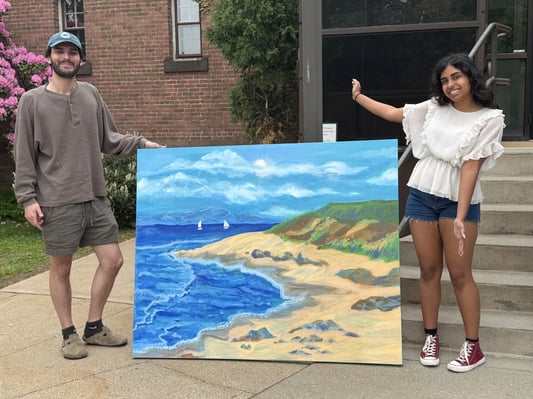
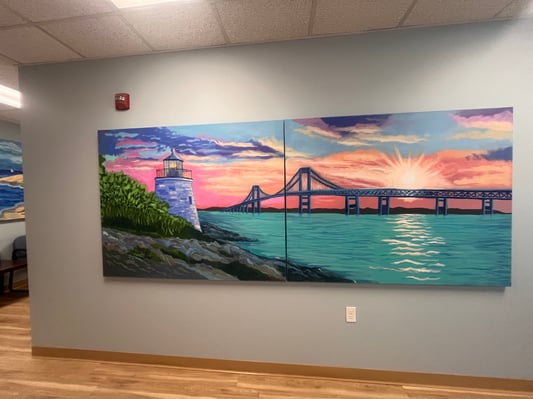
There is something new to see on the third floor of the Memory and Aging Program's outpatient building. Where there was once a bare blue wall, visitors now find three hand-painted canvases capturing two places close to many Rhode Islanders' hearts: the Newport Bridge at sunset and a quiet beach on Block Island.
The artwork is the result of a collaboration between MAP and two recent Brown University graduates, Rishika Kartik and Jackson Ruddick, who created the pieces through a grant from the Brown Arts Institute. The project grew out of MAP's ongoing partnership with Brown professor Dr. Chuck Toth, whose students volunteer with the program as part of a community engagement initiative. Rishika and Jackson took that connection a step further, choosing to devote their arts grant to creating something lasting for the people who spend time in our space.
“We're so grateful that the students chose to create this thoughtful art for our space. It's been such a meaningful collaboration, reflecting a connection between healthcare, education, and the arts.” — Athena Lavoie, MAP Outreach Manager
After meeting with MAP staff to talk through the program's goals and patient population, Rishika and Jackson toured the outpatient building and settled on a newly painted blue waiting area on the third floor. The choice was deliberate.
“We liked that in this space, there was a confluence of many people, researchers, patients, families, clinicians, staff, who could be brought together via art,” Rishika said.
A waiting area also offered something the artists valued: unhurried time, allowing viewers to take in the art at their own pace. Its generous wall space gave the pair room to work at a scale that could make a real visual impact.
The pair built three canvases from scratch, frames and all, depicting two scenes that community members identified as personally meaningful. “Our research showed that familiar, meaningful places can help support memory and create a sense of community, since residents can bond over shared affection for these locations,” Rishika explained.
Color, scale, and detail were all chosen with the audience in mind. Drawing on research into Alzheimer's care settings, the artists selected a palette that felt harmonious with the rest of Butler while also being joyful and calming. They worked at a large scale to accommodate viewers who may struggle with fine detail or feel overwhelmed. The paintings aim for enough realism to evoke the warmth of the sun or the sound of the waves, while leaving other passages abstract so viewers can fill in details for themselves.
For people navigating memory concerns or waiting for an appointment, a clinical space can carry a lot of uncertainty. The pieces were also designed to gently support cognitive function, giving viewers details to notice, encouraging positive memories, and creating a shared centerpiece for people to connect over.
The project grew out of MAP's collaboration with Dr. Toth, but for Rishika and Jackson, it became something more personal.
“I believe all people are creative, and that anyone can create local change by bringing their passions and a learning mindset to an issue they care about,” Rishika said.
Their canvases now greet everyone who passes through the third floor. We hope you will take a moment to enjoy the view.